Key Takeaways
- Over 85% of social growth websites operate as downstream middlemen reselling API calls across multi-hop networks with added margins.
- A true main smm panel controls upstream server clusters, private sim banks, and direct database ingress nodes.
- Evaluating an smm panel global distribution network requires auditing endpoint latency (sub-250ms), server refill scripts, and automated webhook callbacks.
- Connecting your reseller site directly to wholesale upstream providers cuts dispatch delay and eliminates redundant markup fees.
The global social media marketing ecosystem handles billions of automated micro-transactions every day. From high-retention video signals to channel subscriber synchronization, digital marketing agencies routinely rely on external infrastructure to satisfy client campaign volumes.
However, navigating this industry reveals a complex web of intermediaries. The vast majority of storefronts are simply child panels chained together through third-party APIs, marking up prices at each step. To build a sustainable agency or large-scale reseller platform, technical buyers must source directly from an authentic main smm panel that commands direct server infrastructure.
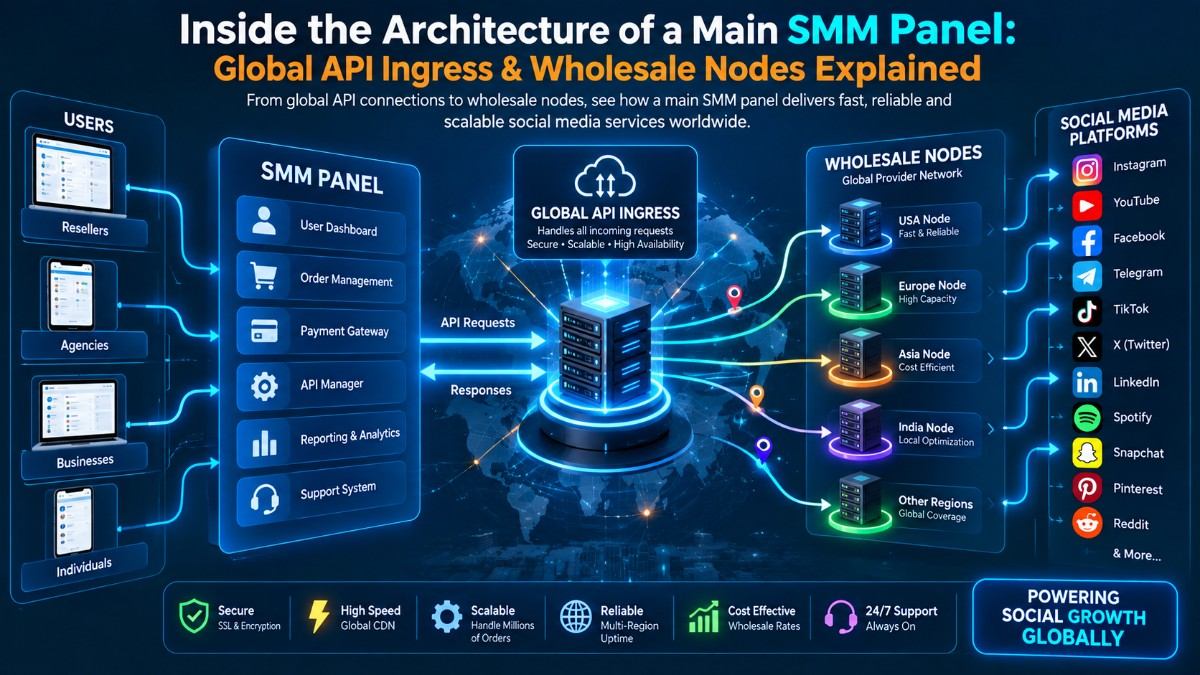
Below is a breakdown of how upstream wholesale networks operate, how an smm panel global node routes orders, and how to verify direct provider status.
1. Anatomy of the SMM Supply Chain: Brokers vs. Source Providers
To understand why execution delays and price inflation happen, it helps to examine how orders travel across the web before landing on platform servers:
- Tier-3 Retail Resellers: Entry-level platforms that run on pre-configured templates. Every customer order is automatically forwarded via standard API to an upstream vendor with a 100% to 300% retail price markup.
- Tier-2 Regional Aggregators: Platforms that curate multi-regional databases, consolidating services from several countries into a unified catalog.
- Tier-1 Main Providers: The foundational layer. A primary provider maintains private device farms, residential proxy backbones, and server-side automation engines. They supply raw endpoints directly to international brokers.
When seeking top-tier infrastructure for high-velocity regional campaigns, agencies rely on established wholesale nodes such as smm panel india to bypass intermediary latency and access unfiltered provider-level rates.
2. Core Technical Criteria of an Enterprise Global SMM Panel
Differentiating between a simple API script reseller and a robust smm panel global hub comes down to evaluating infrastructure performance metrics:
| Technical Parameter | Standard Reseller Reseller | Tier-1 Main Provider Node |
|---|---|---|
| REST API Latency | 1,200ms – 3,500ms (Multi-hop relay) | Sub-250ms (Direct endpoint ingress) |
| Drop Detection | Manual ticket checks | Automated CRON refill & Webhook alerts |
| Throughput Capacity | Limited by upstream wallet balances | Uncapped concurrent API worker threads |
| Cost Structure | Retail markup with platform fees | Raw wholesale pricing (from ₹0.01/1k) |
3. Why API Latency & Ingress Speed Determine Reseller Margins
When running automated multi-order campaigns, seconds matter. If an agency client orders high-velocity livestream engagement or rapid-dispatch trending signals, an order routed through four sequential reseller APIs often sits pending for 10 to 30 minutes.
Direct infrastructure platforms maintain dedicated queue workers (such as Redis-backed microservice pipelines) that ingest orders instantly. This level of system engineering is why high-volume distributors partner with the best smm panel to secure reliable API uptime and programmatic failovers.
Furthermore, sourcing services through a streamlined cheap smm panel gives developers and agency founders the financial overhead needed to maintain competitive pricing models across their downstream customer portals.
4. Safeguarding Delivery: Automated Refills and Anti-Purge Algorithms
Platform security filters on networks like Instagram, YouTube, X, and Telegram update their spam filters on a continuous cycle. Low-tier bots get caught in sweeps, causing sharp drop-offs in channel counts.
A legitimate main smm panel mitigates this algorithmic friction using two specific methods:
- Algorithmic Drip-Feeding: Dispersing order fulfillment over natural time intervals rather than pushing tens of thousands of interactions simultaneously.
- Persistent Node Monitoring: Automated scrapers regularly ping public account counters. If numbers fall below start-count thresholds within warranty windows (30 to 365 days), auto-refill triggers dispatch fresh interactions without manual intervention.
Frequently Asked Questions
What is the difference between a reseller panel and a main smm panel?
How can I tell if an smm panel global provider is direct?
Can I integrate a main panel's API directly with my child panel?

Sarthak has over 8 years of experience in scaling Indian social media brands. He specializes in high-retention growth strategies and monetization compliance. View Full Profile & Articles View Author Profile →