Key Takeaways
- When analyzing twitter trending vs twitter ads, official Promoted Trends carry high price tags that strain campaign budgets.
- Standard feed ads suffer from ad blindness, whereas trending hashtags generate high curiosity and organic participation.
- Wholesale trending services deliver significantly lower effective cost-per-thousand impressions (CPM) by catalyzing secondary organic reach.
- Direct Tier-1 SMM infrastructure provides a scalable, cost-effective method to trigger regional viral momentum safely.
When launching a new product, film trailer, or corporate PR campaign, marketing directors face a critical strategic decision: where should the launch budget be deployed for maximum impact? On X (formerly Twitter), the two primary avenues for paid visibility are standard native ad campaigns (Promoted Posts / Official Takeovers) and algorithmic trending campaigns.
While native advertising offers controlled targeting, it also comes with increasing customer acquisition costs and the reality of user "ad blindness." Conversely, holding a top spot on the "Trending in India" board creates immediate cultural relevance and organic curiosity that traditional ad formats struggle to replicate.
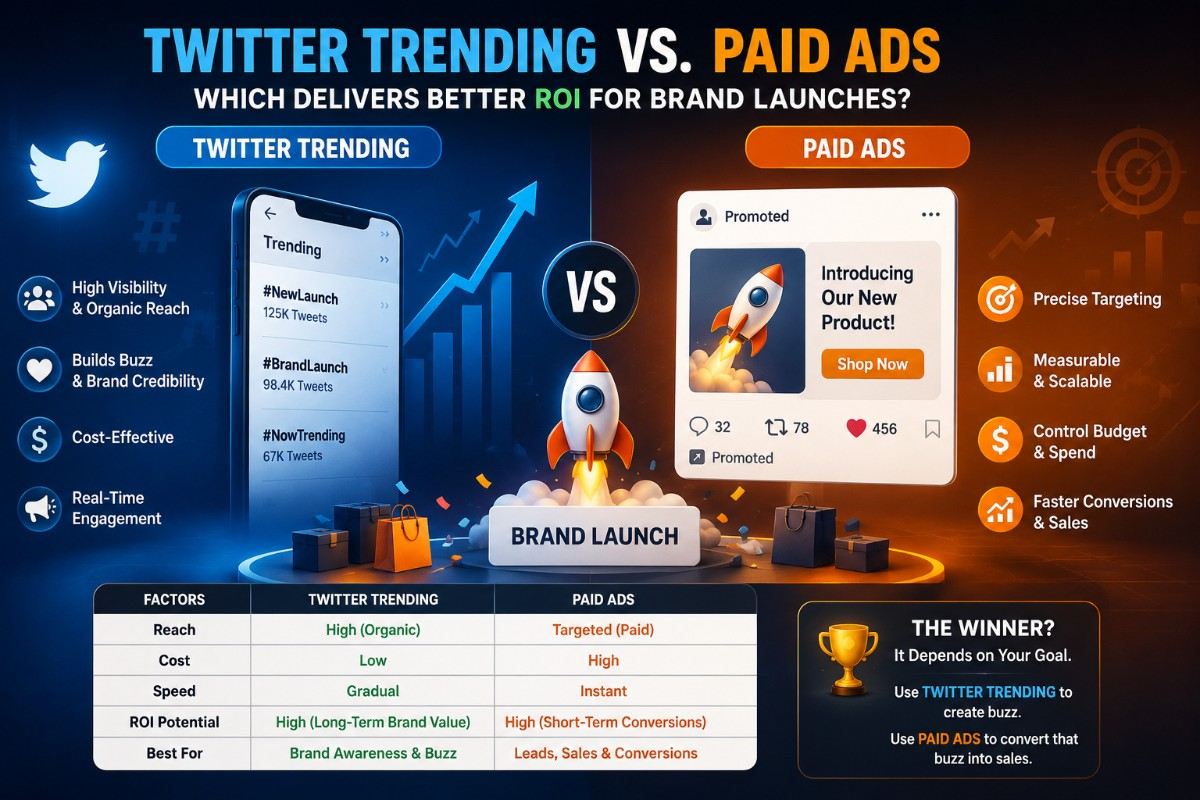
In this detailed comparative guide, we analyze twitter trending vs twitter ads across cost-per-impression (CPM), organic pickup, and social proof, helping you determine which strategy yields the best return on investment (ROI) for your brand launch.
1. Cost-Per-Impression (CPM) & Financial Efficiency
The primary consideration for media buyers is cost efficiency. Official X "Promoted Trend" takeovers are sold as premium placements, often costing tens of thousands of dollars for a 24-hour national run. For most mid-sized enterprises and digital marketing agencies, this pricing creates a steep barrier to entry.
Standard in-feed Promoted Tweets operate on an auction-based CPM model. While more accessible, ad spend can drain rapidly during competitive launch days without guaranteeing widespread conversation.
By contrast, deploying an optimized Twitter trending package allows agencies to generate targeted velocity at wholesale base rates. By delivering concentrated, multi-author interaction bursts during prime hours, brands achieve millions of blended impressions at a fraction of the cost of official takeover formats.
2. Organic Pickup vs. Ad Blindness
The psychological response of users differs dramatically between a sponsored advertisement and a trending topic:
The Ad Blindness Barrier
Modern internet users are conditioned to scroll past posts marked with the "Promoted" or "Ad" tag. Even high-budget video ads often register low watch time and minimal retweets because audiences perceive them as commercial interruptions.
The Trending Curiosity Engine
When a hashtag sits at #1 to #5 on the regional trending list, users click out of organic curiosity: "Why is everyone talking about this right now?" This curiosity triggers authentic secondary actions—real users retweet, quote with their own opinions, and create memes. This organic snowball effect delivers earned media value that paid banner ads cannot match.
3. Social Proof & Media Authority
A successful brand launch requires more than raw impressions; it demands credibility. Holding a national trending topic generates authoritative social proof in three distinct ways:
- Journalist & PR Pickup: Media outlets and bloggers monitor the trending board for real-time news hooks. A trending launch often leads to earned editorial write-ups without direct media outreach costs.
- Community Momentum: Consumers view trending products as popular and vetted by the broader public, accelerating purchase decisions.
- Algorithmic Cross-Pollination: High conversation velocity signals importance across X's recommendation engine, pushing related anchor posts into "For You" feeds organically.
Strategic Hybrid Deployment with Wholesale Infrastructure
For enterprise growth strategists, the most effective modern playbook is a coordinated hybrid strategy: create compelling creative assets, publish an authoritative anchor post, and utilize the cheapest smm panel infrastructure to ignite rapid algorithmic velocity.
By sourcing your delivery through direct residential proxy networks and localized mobile nodes, your campaign secures top-tier trending rankings while maintaining complete algorithmic compliance and preserving campaign budget.
The Bottom Line
While standard Twitter ads offer granular audience filtering, high-velocity trending campaigns remain the undefeated champion for launch-day awareness, buzz generation, and CPM efficiency. By leveraging dedicated wholesale trending infrastructure, brands can dominate regional conversations, bypass ad fatigue, and maximize their launch ROI.
Frequently Asked Questions About Twitter Trending vs Ads

Sarthak has over 8 years of experience in scaling Indian social media brands. He specializes in high-retention growth strategies and monetization compliance. View Full Profile & Articles View Author Profile →